It’s that time of year again to break out the Christmas sweaters–or, as they’re known across the pond, jumpers. ODD London launched a holiday campaign for U.K. retailer Marks & Spencer with an enthusiastic ad honoring everyone’s favorite fuzzy festive garment. In the spot, an office is thoroughly overcome by the holiday spirit as jumper-clad…
When you want to get your message in front of the right people on social media, where do you turn?
More and more, brands and businesses are turning to social ads and custom audiences. You can do a lot of awesome, targeted messaging by focusing on the right audiences with your ads — whether you’re talking to a group of customers, a bunch of website visitors, or a list of subscribers
In this post, we’ll talk you through ways to build custom audiences and lookalike audiences on all the major social media platforms, plus share a couple ideas of how you can put these audiences to the best use.
Best wishes for some well-targeted, highly successful ads!
Since this blog post focuses specifically on audiences, let’s start there. In general, an audience is going to be the bucket of people who will potentially see your ad. This group can be customized based on a variety of factors, which we’ll get to in a minute.
A custom audience is a step beyond the basic demographic and psychographic audience filters. A custom audience can be based on an outside source like a set of emails or website visitors or on the social media behavior of users.
Types of custom audiences you can build within Facebook
And then you have lookalike audiences, which take one of your custom audience and expand it to a larger group based on the qualities that the custom audience has in common. For instance, if all the people in your custom audience are interested in augmented reality, use social on a tablet, and have master’s degrees, then a lookalike audience will include people who share these attributes, too.
How to create a lookalike audience for Facebook / Instagram
As you can tell, there are many ways to slice and dice this information to build some really unique audiences.
So let’s get dive into some of the details, starting with the biggest and most robust social advertising networks … Facebook and Instagram.
How to Create Custom Audiences for Facebook and Instagram Ads
Advertising for both Facebook and Instagram is combined into the Facebook Ads Manager. You can run all your ads from here as well as create and manage all your audiences.
1. A customer list — also known as a standard custom audiences.
This audience is based on a list of emails, phone numbers, or Facebook user IDs that Facebook can then take and match to its list of users. Typically you’ll find that Facebook can match between 60 and 70 percent of the contacts on your customer list.
2. You can create a website custom audience.
With this audience, instead of uploading a list of customer emails or phone numbers, you build the audience based on traffic to your website. Using Facebook Pixel tracking, you can create an audience of people who have visited any specific page on your website during a set time period.
3. You can create custom audiences based on app activity
If you happen to have a mobile app or game, you can build audiences based on the actions that people take within your product.
4. You can use offline activity to build a Facebook audience.
This could include things like conversations that happen offline in brick-and-mortar stores or information you collect on a spreadsheet.
5. Build an audience from Facebook and Instagram engagement
These can be based on who engages with your posts, videos, events, and profile. You can even set the timeframe of this engagement so that you’re building an audience of people who recently engaged, like in the last 90 days, or who engaged anytime in the past year.
Strategy Ideas for Making the Most of Your Custom Audiences
Jumping quickly into the strategy of ads and audiences, we thought this nugget from a recent Jon Loomer blog post was really interesting. In the blog post, they shared that the most popular Instagram audience strategy is lumping all audience types and time windows together into one large chunk — like, everyone who engaged with your profile in the last 365 days, for instance.
As you might guess, there is so much more you can be doing with these audiences!
Let’s take a closer look at engagement audiences for instance: With the robust filtering of Facebook’s ads tool, you can build audiences of engagers based on a huge number of different factors like who has visited your Instagram profile, messaged you, or saved a post or an ad.
When it comes to these custom audiences, we quite liked this tip from social media today:Building “warm” audiences of people who have engaged with your content within a recent timeframe. Video in particular is a useful engagement and attention metric. So, say you create a ‘warm’ audience of people who’ve watched a certain amount of video from your page. From there, you can create a Lookalike Audience based on the warm audience, which will allow you to expand your reach to include people who share similar behaviors to that initial, warm, engaged group.
The Jon Loomer blog has a few favorite audience tips, too, specifically around building engagement-based audiences. These include:
People who have engaged in any way with your brand on Instagram in the past seven days, the past 20 days, and the past 90 days.
People who have visited your Instagram profile in the past 30 days but who are not customers
and People who have viewed your Instagram Stories videos in the past seven days
Another way to work with custom audiences is through retargeting.
This gets at the custom audience type of pixel tracking and website / profile visits.
We’ve talked to lots of brands that start out with targeting anyone and everyone that visits their website in their retargeting campaigns. Needless to say that approach isn’t always the most effective.
Customers visit your website for lots of different reasons. They visit different pages. The pages they visit represent different buyer intents. Perhaps they’re not looking to buy your product at all. The key is to match your custom advertising audiences to those shoppers’ intents. For example, if you’re an e-commerce brand and someone visits your website shopping for shoes, make sure that you segment those people into a custom audience labeled “shoe shoppers” or “footwear.”
Over the past year at Buffer we’ve created various audiences based on the subject matter our visitors are interested in learning about. We have a custom audience for traffic to all Facebook marketing pages, Instagram marketing, customer experience, case studies, etc. That allows us to be hyper-focused on what type of content we deliver, which helps to drive down costs.
As you’ll find with all of these social networks, they’re not quite as robust with ads offerings as Facebook and Instagram. But that’s okay! There’s still plenty of customization you can do.For Pinterest, you have a few options for what to create when it comes to customer audiences.
You can build audiences
Based on visitors who went to your site
Through a customer list that you upload — like a list of emails
Based on people who engaged with pins that link to your website
With an actalike audience that behaves similarly to an existing custom audience that you’ve created
Pinterest audience options
The visitor audience is based on a Pinterest tag, very much like the Facebook pixel. The Pinterest tag is a piece of JavaScript code you can install on your website to gather conversion insights and to build audiences that you can then target, based on actions taken on your site.
The Pinterest engagement audiences are really interesting, too. For these, all you need is to confirm your domain with Pinterest, and then Pinterest will be able to check to see which Pinterest users have engaged with pins that link back to your website. So for instance, if 1,000 people had saved a pin of Buffer blog content, we could build an engagement audience based on this.
Similar to the Facebook and Instagram engagement audiences, Pinterest gives you a handful of options to further customize this group. You can filter based on a specific URL, based on a pin category, or even based on the percentage of video that’s been viewed.
One interesting way that e-commerce brands can use this is to create audiences that are interested in particular product categories — people who click on certain links or certain Pins.
How to Create Custom Audiences for Twitter
With Twitter ads, you can build custom audiences based on
An uploaded list of contacts or customers
A collection of website visitors based on data you get from using a Twitter website tag
A list of your mobile app users
A flexible audience.
Twitter audience options
The flexible audiences feature is similar in nature to some of the engagement audiences we’ve talked about before. These audiences give Twitter advertisers a way to save combinations of audiences and subsets of audiences, based on factors like recency and frequency of interactions.
How to Create Custom Audiences for LinkedIn
You can build custom audiences on LinkedIn based on a list of contacts that you upload or you can build audiences based on website data, captured using a LinkedIn tag.
LinkedIn audience options
One interesting bit of audience customization that LinkedIn provides is with account-based audiences. Let’s say that you want to get a certain percentage of Fortune 500 companies using your product; well, you can upload this list of accounts to LinkedIn and build a custom audience that focused on the stakeholders of these companies.
Yes, there’s a lot of interesting things you can do on LinkedIn if you’re a business selling to other businesses. Then of course Facebook, Instagram, Pinterest, and Twitter are all great for selling your products and services direct to consumers.
That’s right, and before we go, we’d love to leave you with just a couple more ideas for how you can use these custom audiences in unique ways.
More Tips for Getting the Most out of Your Custom Audiences
I thought this tip from AdEspresso was pretty intriguing.They boost a lot of their content to a wide audience and then create a custom audience based on people who click that content and visit the website. This custom website audience, then, is made up of people who have already shown a lot of intent and might be more primed to start a trial.
Another exciting way to use custom audiences is to think creatively about what you share with a custom audience of existing customers. Typically you might think of ads as a way to acquire more customers. But what if you used this list as a way to keep existing customers engaged? You can build a custom audience based on people who have shopped with you in the past or used your product before, but it’s been awhile since they returned — a “sleepy” audience of sorts.
And finally, there are some neat things you can do with custom audiences of newsletter subscribers. You can segment the list into audiences of engaged subscribers and disengaged subscribers and deliver unique content to each group. For the disengaged group in particular there’s a lot of value in re-engaging: MailChimp ran an analysis of 60 million e-commerce purchases and 40 million email addresses from retailers and found that a single inactive subscriber is still worth 32% of an active subscriber.
About the Science of Social Media
The Science of Social Media is your weekly sandbox for social media stories, insights, experimentation, and inspiration. Every Monday (and sometimes more) we share the most cutting-edge social media marketing strategies from brands and influencers in every industry. If you’re a social media team of one, business owner, marketer, or someone simply interested in social media marketing, you’re sure to find something useful in each episode. It’s our hope that you’ll join our 27,000+ listeners each week and rock your social media channels as a result!
What is the first thing you do when you need new marketing ideas? What about when you decide it’s time to change the way you keep the books finally? Or even notice a flat tire in the car?
Faced with a problem, challenge or even a choice, they google it. Simply.
And so, it’s a cold, harsh truth that without at least some presence in Google, your business is unlikely to survive long.
In this guide, you’ll discover a strategy to build this presence – Search Engine Optimization (SEO.)
You’ll learn what SEO is, how it works, and what you must do to position your site in search engine results.
But before we begin, I want to reassure you of something.
So many resources make SEO complex. They scare readers with technical jargon, focus on advanced elements, and rarely explain anything beyond theory.
I promise you, this guide isn’t like that.
In the following pages, I’m going to break SEO into its most basic parts and show you how to use all its elements to construct a successful SEO strategy. (And to stay up-to-date on SEO strategy and trends, check out HubSpot’s Skill Up podcast.)
Keep on reading to understand SEO, or jump ahead to the section that interests you most.
When asked to explain what SEO is, I often choose to call it a strategy to ensure that when someone googles your product or service category, they find your website.
But this simplifies the discipline a bit. It doesn’t take elements like different customer information needs into consideration. However, it does reveal its essence.
In short, SEO drives two things — rankings and visibility.
Rankings
This is a process that search engines use to determine where to place a particular web page in SERPs.
Visibility
This term describes how prominent a particular domain is in search engine results. With high visibility, your domain is prominent in SERPs. Lower search visibility occurs when a domain isn’t visible for many relevant search queries.
Both are responsible for delivering the main SEO objectives – traffic and conversions.
There is one more reason why you should be using SEO.
The discipline helps you position your brand throughout almost the entire buying journey.
In turn, it can ensure that your marketing strategies match the new buying behavior.
Because, as Google admitted themselves – customer behavior has changed forever.
Today, more people use search engines to find products or services than any other marketing channel. 18% more shoppers choose Google over Amazon. 136% more prefer the search engine to other retail websites. And B2B buyers conduct up to 12 searches, on average, before engaging with a brand.
What’s more, they prefer going through the majority of the buying process on their own.
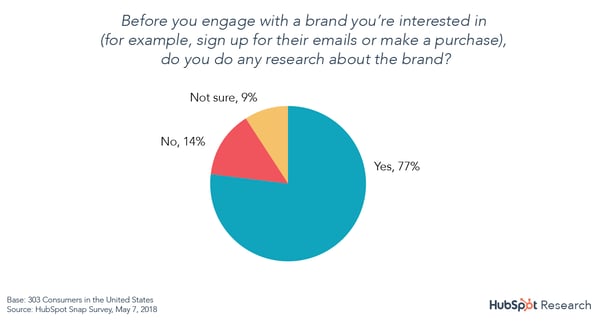
For example, in recent survey from HubSpot Research, we found that 77% people research a brand before engaging with it.
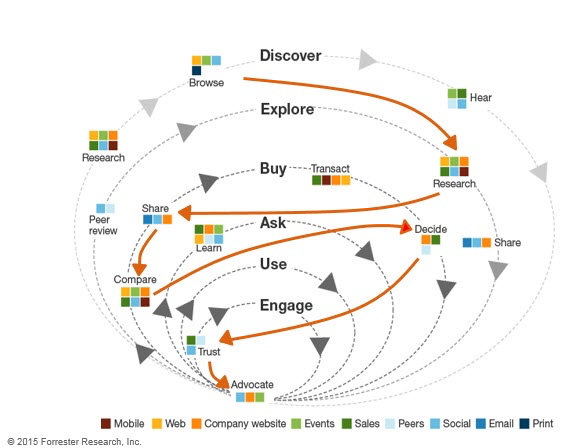
Forrester revealed that 60% of customers do not want any interaction with salespeople. Further, 68% prefer to research on their own. And 62% have developed their own criteria to select the right vendor.
What’s more, this process has never been more complicated.
Finally, DemandGen’s 2017 B2B Buyer’s Survey found that 61% of B2B buyers start the buying process with a broad web search. In comparison, only 56% go directly to a vendor’s website.
But how do they use search engines during the process?
Early in the process, they use Google to find information about their problem. Some also inquire about potential solutions.
Then, they evaluate available alternatives based on reviews or social media hype before inquiring with a company. But this happens after they’ve exhausted all information sources.
And so, the only chance for customers to notice and consider you is by showing up in their search results.
Search engines have a single goal only. They aim to provide users with the most relevant answers or information.
Every time you use them, their algorithms choose pages that are the most relevant to your query. And then, rank them, displaying the most authoritative or popular ones first.
To deliver the right information to users, search engines analyze two factors:
Relevancy between the search query and the content on a page. Search engines assess it by various factors like topic or keywords.
Authority, measured by a website’s popularity on the Internet. Google assumes that the more popular a page or resource is, the more valuable is its content to readers.
And to analyze all this information they use complex equations calledsearch algorithms.
Search engines keep their algorithms secret. But over time, SEOs have identified some of the factors they consider when ranking a page. We refer to them as ranking factors, and they are the focus of an SEO strategy.
As you’ll shortly see, adding more content, optimizing image filenames, or improving internal links can affect your rankings and search visibility. And that’s because each of those actions improves a ranking factor.
Three Core Components of a Strong SEO Strategy
To optimize a site, you need to improve ranking factors in three areas — technical website setup, content, and links. So, let’s go through them in turn.
1. Technical Setup
For your website to rank, three things must happen:
First, a search engine needs find your pages on the Web.
Then, it must scan them to understand their topics and identify their keywords.
And finally, it needs to add them to its index — a database of all the content it has found on the web. This way, its algorithm can consider displaying your website for relevant queries.
Seem simple, doesn’t it? Certainly, nothing to worry about. After all, since you can visit your site without any problem, so should Google, right?
Unfortunately, there is a catch. A web page looks different for you and the search engine. You see it as a collection of graphics, colors, text with its formatting, and links.
To a search engine, it’s nothing but text.
As a result, any elements it cannot render this way remain invisible to the search engine. And so, in spite of your website looking fine to you, Google might find its content inaccessible.
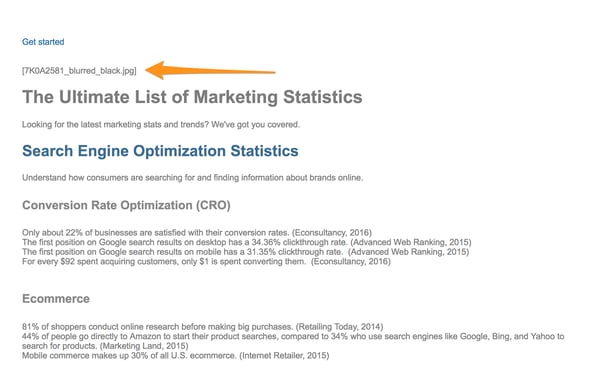
Let me show you an example. Here’s how a typical search engine sees one of our articles. It’s this one, by the way, if you want to compare it with the original.
Notice some things about it:
The page is just text. Although we carefully designed it, the only elements a search engine sees are text and links.
As a result, it cannot see an image on the page (note the element marked with an arrow.) It only recognizes its name. If that image contained an important keyword we’d want the page to rank for, it would be invisible to the search engine.
That’s where technical setup, also called on-site optimization, comes in.
It ensures that your website and pages allow Google to scan and index them without any problems.
And the most important factors affecting it include:
Website navigation and links
Search engines crawl sites just like you would. They follow links. Search engine crawlers land on a page and use links to find other content to analyze. But as you’ve seen above, they cannot see images. So, set the navigation and links as text-only.
Simple URL structure
Search engines don’t like reading lengthy strings of words with complex structure. So, if possible, keep your URLs short. Set them up to include as little beyond the main keyword for which you want to optimize the page, as possible.
Page speed
Search engines, use the load time — the time it takes for a user to be able to read the page — as an indicator of quality. Many website elements can affect it. Image size, for example. Use Google’s Page Speed Insights Tool for suggestions how to improve your pages.
Dead links or broken redirects
A dead link sends a visitor to a nonexistent page. A broken redirect points to a resource that might no longer be there. Both provide poor user experience but also, prevent search engines from indexing your content.
Sitemap and Robots.txt files
A sitemap is a simple file that lists all URLs on your site. Search engines use it to identify what pages to crawl and index. A robots.txt file, on the other hand, tells search engines what content not to index (for example, specific policy pages you don’t want to appear in search.) Create both to speed up crawling and indexing of your content.
Duplicate content
Pages containing identical or quite similar content confuse search engines. They often find it near impossible to determine what content they should display in search results. For that reason, search engines consider duplicate content as a negative factor. And upon finding it, can penalize a website by not displaying any of those pages at all.
Every time you use a search engine, you’re looking for content — information on a particular issue or problem, for example.
True, this content might come in different formats. It could be text, like a blog post or a web page. But it could also be a video, product recommendation, and even a business listing.
It’s all content.
And for SEO, it’s what helps gain greater search visibility.
Here are two reasons why:
For one, content is what customers want when searching. Regardless of what they’re looking for, it’s content that provides it. And the more of it you publish, the higher your chance for greater search visibility.
But also, search engines use content to determine how to rank a page. It’s the idea of relevance between a page and a person’s search query that we talked about earlier.
While crawling a page, they determine its topic. Analyzing elements like page length or its structure helps them assess its quality. Based on this information, search algorithms can match a person’s query with pages they consider the most relevant to it.
The process of optimizing content begins with keyword research.
Keyword Research
SEO is not about getting any visitors to the site. You want to attract people who need what you sell and can become leads, and later, customers.
However, that’s possible only if it ranks for the keywords those people would use when searching. Otherwise, there’s no chance they’d ever find you. And that’s even if your website appeared at the top of the search results.
That’s why SEO work starts with discovering what phrases potential buyers enter into search engines.
The process typically involves identifying terms and topics relevant to your business. Then, converting them into initial keywords. And finally, conducting extensive research to uncover related terms your audience would use.
We’ve published a thorough guide to keyword research for beginners. It lays out the keyword research process in detail. Use it to identify search terms you should be targeting.
With a list of keywords at hand, the next step is to optimize your content. SEOs refer to this process as on-page optimization.
On-Page Optimization
On-page optimization, also called on-page SEO, ensures that search engines a.) understand a page’s topic and keywords, and b.) can match it to relevant searches.
Note, I said “page” not content. That’s because, although the bulk of on-page SEO work focuses on the words you use, it extends to optimizing some elements in the code.
You may have heard about some of them — meta-tags like title or description are two most popular ones. But there are more. So, here’s a list of the most crucial on-page optimization actions to take.
Note: Since blog content prevails on most websites, when speaking of those factors, I’ll focus on blog SEO — optimizing blog posts for relevant keywords. However, all this advice is equally valid for other page types too.
First, ensure that Google understands what keywords you want this page to rank. To achieve that, make sure you include at least the main keyword in the following:
Post’s title: Ideally, place it as close to the start of the title. Google is known to put more value on words at the start of the headline.
URL: Your page’s web address should also include the keyword. Ideally, including nothing else. Also, remove any stop words.
H1 Tag: In most content management systems, this tag displays the title of the page by default. However, make sure that your platform doesn’t use a different setting.
The first 100 words (or the first paragraph) of content: Finding the keyword at the start of your blog post will reassure Google that this is, in fact, the page’s topic.
Meta-title and meta-description tags: Search engines use these two code elements to display their listings. They display meta-title as the search listing’s title. Meta-description provides content for the little blurb below it. But above that, they use both to understand the page’s topic further.
Image file names and ALT tags: Remember how search engines see graphics on a page? They can only see their file names. So, make sure that at least one of the images contains the keyword in the file name.
The alt tag, on the other hand, is text browsers display instead of an image (for visually impaired visitors.) However, since ALT tag resides in the image code, search engines use it as a relevancy signal as well.
Also, add semantic keywords — variations or synonyms of your keyword. Google and other search engines use them to determine a page’s relevancy better.
Let me illustrate this with a quick example. Let’s pretend that your main keyword is “Apple.” But do you mean the fruit or the tech giant behind the iPhone?
Now, imagine what happens when Google finds terms like sugar, orchard, or cider in the copy? The choice what queries to rank it for would immediately become obvious, right?
That’s what semantic keywords do. Add them to ensure that your page doesn’t start showing up for irrelevant searches.
ii. Non-Keyword-Related On-Page Optimization Factors
On-page SEO is not just about sprinkling keywords across the page. The factors below help confirm a page’s credibility and authority too:
External links: Linking out to other, relevant pages on the topic helps Google determine its topic further. Plus, it provides a good user experience. How? By positioning your content as a valuable resource.
Internal links: Those links help you boost rankings in two ways. One, they allow search engines to find and crawl other pages on the site. And two, they show semantic relations between various pages, helping to determine its relevance to the search query better. As a rule, you should include at least 2-4 internal links per blog post.
Content’s length:Long content typically ranks better. That’s because, if done well, a longer blog post will always contain more exhaustive information on the topic.
Multimedia: Although not a requirement, multimedia elements like videos, diagrams, audio players can signal a page’s quality. It keeps readers on a page for longer. And in turn, it signals that they find the content valuable and worth perusing.
3. Links
From what you’ve read in this guide so far, you know that no page will rank without two factors — relevance and authority.
In their quest to provide users with the most accurate answers, Google and other search engines prioritize pages they consider the most relevant to their queries but also, popular.
The first two areas — technical setup and content — focused on increasing relevancy (though I admit, some of their elements can also help highlight the authority.)
Links, however, are responsible for popularity.
But before we talk more about how they work, here’s what SEOs mean when talking about links.
What Is a Backlink?
Links, also called backlinks, are references to your content on other websites. Every time another website mentions and points their readers to your content, you gain a backlink to your site.
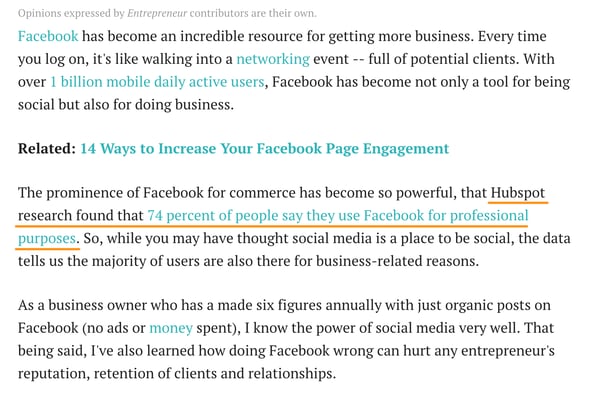
For example, this article in Entrepreneur.com mentions our marketing statistics page. It also links to it allowing their readers to see other stats than the one quoted.
Google uses quantity and quality of links like this as a signal of a website’s authority. Its logic behind it is that webmasters would reference a popular and high-quality website more often than a mediocre one.
But note that I mentioned links quality as well. That’s because not all links are the same. Some — low-quality ones — can impact your rankings negatively.
Links Quality Factors
Low quality or suspicious links — for example, ones that Google would consider as built deliberately to make it consider a site as more authoritative — might reduce your rankings.
That’s why, when building links, SEOs focus not on building any links. They aim to generate the highest quality references possible.
Naturally, just like with the search algorithm, we don’t know what factors determine a link’s quality, specifically. However, over time, SEOs discovered some of them:
The popularity of a linking site: Any link from a domain that search engines consider an authority will naturally have high quality. In other words, links from websites that have good quality links pointing to them, work better.
Topic relevance: Links from domains on a topic similar to yours will carry more authority than those from random websites.
Trust in a domain: Just like with popularity, search engines also assess a website’s trust. Links from more trustworthy sites will always impact rankings better.
Link Building
In SEO, we refer to the process of acquiring new backlinks as link building. And as many practitioners admit, it can be a challenging activity.
Link building, if you want to do it well, requires creativity, strategic thinking, and patience. To generate quality links, you need to come up with a link building strategy. And that’s no small feat.
Remember, your links must pass various quality criteria. Plus, it can’t be obvious to search engines that you’ve built them deliberately.
Here are some strategies to do it:
Editorial, organic links. These backlinks come from websites that reference your content on their own.
Outreach. In this strategy, you contact other websites for links. This can happen in many ways. You could create an amazing piece of content, and email them to tell them about it. In turn, if they find it valuable, they’ll reference it. You can also suggest where they could link to it.
Guest posting. Guest posts are blog articles that you publish on third-party websites. In turn, those companies often allow including one or two links to your site in the content and author bio.
Profile links. Finally, many websites offer an opportunity to create a link. Online profiles are a good example. Often, when setting up such profile, you can also list your website there as well. Not all such links carry strong authority, but some might. And given the ease of creating them, they’re worth pursuing.
Competitive analysis. Finally, many SEOs regularly analyze their competitors’ backlinks to identify those they could recreate for their sites too.
Now, if you’re still here with me, then you’ve just discovered what’s responsible for your site’s success in search.
The next step, then, is figuring out whether your efforts are working.
How to Monitor & Track SEO Results
Technical setup, content, and links are critical to getting a website into the search results. Monitoring your efforts helps improve your strategy further.
Measuring SEO success means tracking data about traffic, engagement, and links. And though, most companies develop their own sets of SEO KPIs (key performance indicators), here are the most common ones:
Organic traffic growth
Keyword rankings (split into branded and non-branded terms)
Conversions from organic traffic
Average time on page and the bounce rate
Top landing pages attracting organic traffic
Number of indexed pages
Links growth (including new and lost links)
Local SEO
Up until now, we focused on getting a site rank in search results in general. If you run a local business, however, Google also lets you position it in front of potential customers in your area, specifically. But for that, you use local SEO.
And it’s well worth it.
97% of customers use search engines to find local information. They look for vendor suggestions, and even specific business addresses. In fact, 12% of customers look for local business information every day.
What’s more, they act on this information: 75% of searchers visit a local store or company’s premises within 24 hours of the search.
But hold on, is local SEO different from what we’ve been talking all along?
Yes and no.
Search engines follow similar principles for both local and global rankings. But given that they position a site for specific, location-based results, they need to analyze some other ranking factors too.
Local search results look different too:
They appear only for searches with a local intent (for example, “restaurant near me” or when a person clearly defined the location.)
They contain results specific to a relevant location.
They concentrate on delivering specific information to users that they don’t need to go anywhere else to find.
They target smartphone users primarily as local searches occur more often on mobile devices.
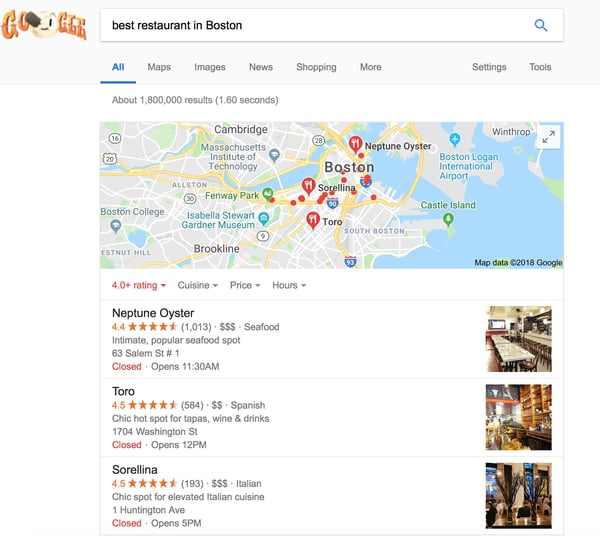
For example, a local pack, the most prominent element of local results, includes almost all information a person would need to choose a business. For example, here are local results Google displays for the phrase “bestrestaurant in Boston.”
Note that these results contain no links to any content. Instead, they include a list of restaurants in the area, a map to show their locations, and additional information about each:
Business name
Description
Image
Opening hours
Star Reviews
Address
Often, they also include a company’s phone number or website address.
All this information combined helps customers choose which business to engage. But it also allows Google to determine how to rank it.
Keywords are essential for local SEO too. However, one additional element of on-page optimization is the presence of a company’s name, address, and phone number of a page. In local SEO, we refer to it as the NAP.
Again, it makes sense, as the search engine needs a way to assess the company’s location.
Google assesses authority in local search not just by links. Reviews and citations (references of a business’s address or a phone number online) highlight its authority too.
Finally, the information a business includes in Google My Business — the search engine’s platform for managing local business listings — plays a huge part in its rankings.
The above is just the tip of the iceberg. But they are the ones to get right first if you want your business to rank well in local search.
What is Black Hat SEO?
The final aspect of SEO I want to highlight to you is something I also hope you’ll never get tempted to use. I mean it.
Because, although it might have its lure, using black hat SEO typically ends in a penalty from search listings.
Black hat practices aim at manipulating search engine algorithms using strategies against search engine guidelines. The most common black hat techniques include keyword stuffing, cloaking (hiding keywords in code so that users don’t see them, but search engines do,) and buying links.
So, why would someone use black hat SEO? For one, because, often, ranking a site following Google’s guidelines takes time. Long time, in fact.
Black hat strategies let you cut down the complexity of link building, for example. Keyword stuffing allows to rank one page for many keywords, without having to create more content assets.
But as said, getting caught often results in a site being completely wiped out from search listings.
And the reason I mention it here is that I want you to realize that there are no shortcuts in SEO. And be aware of anyone suggesting strategies that might seem too good to be true.
SEO Resources & Training
This guide is just a starting point for discovering SEO. But there’s much more to learn.
Without actively positioning its content in search results, no business can survive long.
By increasing your search visibility, you can bring more visitors, and in turn, conversions and sales. And that’s well worth the time spent becoming an expert in SEO.
When you want to get your message in front of the right people on social media, where do you turn?
More and more, brands and businesses are turning to social ads and custom audiences. You can do a lot of awesome, targeted messaging by focusing on the right audiences with your ads — whether you’re talking to a group of customers, a bunch of website visitors, or a list of subscribers
In this post, we’ll talk you through ways to build custom audiences and lookalike audiences on all the major social media platforms, plus share a couple ideas of how you can put these audiences to the best use.
Best wishes for some well-targeted, highly successful ads!
Since this blog post focuses specifically on audiences, let’s start there. In general, an audience is going to be the bucket of people who will potentially see your ad. This group can be customized based on a variety of factors, which we’ll get to in a minute.
A custom audience is a step beyond the basic demographic and psychographic audience filters. A custom audience can be based on an outside source like a set of emails or website visitors or on the social media behavior of users.
Types of custom audiences you can build within Facebook
And then you have lookalike audiences, which take one of your custom audience and expand it to a larger group based on the qualities that the custom audience has in common. For instance, if all the people in your custom audience are interested in augmented reality, use social on a tablet, and have master’s degrees, then a lookalike audience will include people who share these attributes, too.
How to create a lookalike audience for Facebook / Instagram
As you can tell, there are many ways to slice and dice this information to build some really unique audiences.
So let’s get dive into some of the details, starting with the biggest and most robust social advertising networks … Facebook and Instagram.
How to Create Custom Audiences for Facebook and Instagram Ads
Advertising for both Facebook and Instagram is combined into the Facebook Ads Manager. You can run all your ads from here as well as create and manage all your audiences.
1. A customer list — also known as a standard custom audiences.
This audience is based on a list of emails, phone numbers, or Facebook user IDs that Facebook can then take and match to its list of users. Typically you’ll find that Facebook can match between 60 and 70 percent of the contacts on your customer list.
2. You can create a website custom audience.
With this audience, instead of uploading a list of customer emails or phone numbers, you build the audience based on traffic to your website. Using Facebook Pixel tracking, you can create an audience of people who have visited any specific page on your website during a set time period.
3. You can create custom audiences based on app activity
If you happen to have a mobile app or game, you can build audiences based on the actions that people take within your product.
4. You can use offline activity to build a Facebook audience.
This could include things like conversations that happen offline in brick-and-mortar stores or information you collect on a spreadsheet.
5. Build an audience from Facebook and Instagram engagement
These can be based on who engages with your posts, videos, events, and profile. You can even set the timeframe of this engagement so that you’re building an audience of people who recently engaged, like in the last 90 days, or who engaged anytime in the past year.
Strategy Ideas for Making the Most of Your Custom Audiences
Jumping quickly into the strategy of ads and audiences, we thought this nugget from a recent Jon Loomer blog post was really interesting. In the blog post, they shared that the most popular Instagram audience strategy is lumping all audience types and time windows together into one large chunk — like, everyone who engaged with your profile in the last 365 days, for instance.
As you might guess, there is so much more you can be doing with these audiences!
Let’s take a closer look at engagement audiences for instance: With the robust filtering of Facebook’s ads tool, you can build audiences of engagers based on a huge number of different factors like who has visited your Instagram profile, messaged you, or saved a post or an ad.
When it comes to these custom audiences, we quite liked this tip from social media today:Building “warm” audiences of people who have engaged with your content within a recent timeframe. Video in particular is a useful engagement and attention metric. So, say you create a ‘warm’ audience of people who’ve watched a certain amount of video from your page. From there, you can create a Lookalike Audience based on the warm audience, which will allow you to expand your reach to include people who share similar behaviors to that initial, warm, engaged group.
The Jon Loomer blog has a few favorite audience tips, too, specifically around building engagement-based audiences. These include:
People who have engaged in any way with your brand on Instagram in the past seven days, the past 20 days, and the past 90 days.
People who have visited your Instagram profile in the past 30 days but who are not customers
and People who have viewed your Instagram Stories videos in the past seven days
Another way to work with custom audiences is through retargeting.
This gets at the custom audience type of pixel tracking and website / profile visits.
We’ve talked to lots of brands that start out with targeting anyone and everyone that visits their website in their retargeting campaigns. Needless to say that approach isn’t always the most effective.
Customers visit your website for lots of different reasons. They visit different pages. The pages they visit represent different buyer intents. Perhaps they’re not looking to buy your product at all. The key is to match your custom advertising audiences to those shoppers’ intents. For example, if you’re an e-commerce brand and someone visits your website shopping for shoes, make sure that you segment those people into a custom audience labeled “shoe shoppers” or “footwear.”
Over the past year at Buffer we’ve created various audiences based on the subject matter our visitors are interested in learning about. We have a custom audience for traffic to all Facebook marketing pages, Instagram marketing, customer experience, case studies, etc. That allows us to be hyper-focused on what type of content we deliver, which helps to drive down costs.
As you’ll find with all of these social networks, they’re not quite as robust with ads offerings as Facebook and Instagram. But that’s okay! There’s still plenty of customization you can do.For Pinterest, you have a few options for what to create when it comes to customer audiences.
You can build audiences
Based on visitors who went to your site
Through a customer list that you upload — like a list of emails
Based on people who engaged with pins that link to your website
With an actalike audience that behaves similarly to an existing custom audience that you’ve created
Pinterest audience options
The visitor audience is based on a Pinterest tag, very much like the Facebook pixel. The Pinterest tag is a piece of JavaScript code you can install on your website to gather conversion insights and to build audiences that you can then target, based on actions taken on your site.
The Pinterest engagement audiences are really interesting, too. For these, all you need is to confirm your domain with Pinterest, and then Pinterest will be able to check to see which Pinterest users have engaged with pins that link back to your website. So for instance, if 1,000 people had saved a pin of Buffer blog content, we could build an engagement audience based on this.
Similar to the Facebook and Instagram engagement audiences, Pinterest gives you a handful of options to further customize this group. You can filter based on a specific URL, based on a pin category, or even based on the percentage of video that’s been viewed.
One interesting way that e-commerce brands can use this is to create audiences that are interested in particular product categories — people who click on certain links or certain Pins.
How to Create Custom Audiences for Twitter
With Twitter ads, you can build custom audiences based on
An uploaded list of contacts or customers
A collection of website visitors based on data you get from using a Twitter website tag
A list of your mobile app users
A flexible audience.
Twitter audience options
The flexible audiences feature is similar in nature to some of the engagement audiences we’ve talked about before. These audiences give Twitter advertisers a way to save combinations of audiences and subsets of audiences, based on factors like recency and frequency of interactions.
How to Create Custom Audiences for LinkedIn
You can build custom audiences on LinkedIn based on a list of contacts that you upload or you can build audiences based on website data, captured using a LinkedIn tag.
LinkedIn audience options
One interesting bit of audience customization that LinkedIn provides is with account-based audiences. Let’s say that you want to get a certain percentage of Fortune 500 companies using your product; well, you can upload this list of accounts to LinkedIn and build a custom audience that focused on the stakeholders of these companies.
Yes, there’s a lot of interesting things you can do on LinkedIn if you’re a business selling to other businesses. Then of course Facebook, Instagram, Pinterest, and Twitter are all great for selling your products and services direct to consumers.
That’s right, and before we go, we’d love to leave you with just a couple more ideas for how you can use these custom audiences in unique ways.
More Tips for Getting the Most out of Your Custom Audiences
I thought this tip from AdEspresso was pretty intriguing.They boost a lot of their content to a wide audience and then create a custom audience based on people who click that content and visit the website. This custom website audience, then, is made up of people who have already shown a lot of intent and might be more primed to start a trial.
Another exciting way to use custom audiences is to think creatively about what you share with a custom audience of existing customers. Typically you might think of ads as a way to acquire more customers. But what if you used this list as a way to keep existing customers engaged? You can build a custom audience based on people who have shopped with you in the past or used your product before, but it’s been awhile since they returned — a “sleepy” audience of sorts.
And finally, there are some neat things you can do with custom audiences of newsletter subscribers. You can segment the list into audiences of engaged subscribers and disengaged subscribers and deliver unique content to each group. For the disengaged group in particular there’s a lot of value in re-engaging: MailChimp ran an analysis of 60 million e-commerce purchases and 40 million email addresses from retailers and found that a single inactive subscriber is still worth 32% of an active subscriber.
About the Science of Social Media
The Science of Social Media is your weekly sandbox for social media stories, insights, experimentation, and inspiration. Every Monday (and sometimes more) we share the most cutting-edge social media marketing strategies from brands and influencers in every industry. If you’re a social media team of one, business owner, marketer, or someone simply interested in social media marketing, you’re sure to find something useful in each episode. It’s our hope that you’ll join our 27,000+ listeners each week and rock your social media channels as a result!
When you want to get your message in front of the right people on social media, where do you turn?
More and more, brands and businesses are turning to social ads and custom audiences. You can do a lot of awesome, targeted messaging by focusing on the right audiences with your ads — whether you’re talking to a group of customers, a bunch of website visitors, or a list of subscribers
In this post, we’ll talk you through ways to build custom audiences and lookalike audiences on all the major social media platforms, plus share a couple ideas of how you can put these audiences to the best use.
Best wishes for some well-targeted, highly successful ads!
Since this blog post focuses specifically on audiences, let’s start there. In general, an audience is going to be the bucket of people who will potentially see your ad. This group can be customized based on a variety of factors, which we’ll get to in a minute.
A custom audience is a step beyond the basic demographic and psychographic audience filters. A custom audience can be based on an outside source like a set of emails or website visitors or on the social media behavior of users.
Types of custom audiences you can build within Facebook
And then you have lookalike audiences, which take one of your custom audience and expand it to a larger group based on the qualities that the custom audience has in common. For instance, if all the people in your custom audience are interested in augmented reality, use social on a tablet, and have master’s degrees, then a lookalike audience will include people who share these attributes, too.
How to create a lookalike audience for Facebook / Instagram
As you can tell, there are many ways to slice and dice this information to build some really unique audiences.
So let’s get dive into some of the details, starting with the biggest and most robust social advertising networks … Facebook and Instagram.
How to Create Custom Audiences for Facebook and Instagram Ads
Advertising for both Facebook and Instagram is combined into the Facebook Ads Manager. You can run all your ads from here as well as create and manage all your audiences.
1. A customer list — also known as a standard custom audiences.
This audience is based on a list of emails, phone numbers, or Facebook user IDs that Facebook can then take and match to its list of users. Typically you’ll find that Facebook can match between 60 and 70 percent of the contacts on your customer list.
2. You can create a website custom audience.
With this audience, instead of uploading a list of customer emails or phone numbers, you build the audience based on traffic to your website. Using Facebook Pixel tracking, you can create an audience of people who have visited any specific page on your website during a set time period.
3. You can create custom audiences based on app activity
If you happen to have a mobile app or game, you can build audiences based on the actions that people take within your product.
4. You can use offline activity to build a Facebook audience.
This could include things like conversations that happen offline in brick-and-mortar stores or information you collect on a spreadsheet.
5. Build an audience from Facebook and Instagram engagement
These can be based on who engages with your posts, videos, events, and profile. You can even set the timeframe of this engagement so that you’re building an audience of people who recently engaged, like in the last 90 days, or who engaged anytime in the past year.
Strategy Ideas for Making the Most of Your Custom Audiences
Jumping quickly into the strategy of ads and audiences, we thought this nugget from a recent Jon Loomer blog post was really interesting. In the blog post, they shared that the most popular Instagram audience strategy is lumping all audience types and time windows together into one large chunk — like, everyone who engaged with your profile in the last 365 days, for instance.
As you might guess, there is so much more you can be doing with these audiences!
Let’s take a closer look at engagement audiences for instance: With the robust filtering of Facebook’s ads tool, you can build audiences of engagers based on a huge number of different factors like who has visited your Instagram profile, messaged you, or saved a post or an ad.
When it comes to these custom audiences, we quite liked this tip from social media today:Building “warm” audiences of people who have engaged with your content within a recent timeframe. Video in particular is a useful engagement and attention metric. So, say you create a ‘warm’ audience of people who’ve watched a certain amount of video from your page. From there, you can create a Lookalike Audience based on the warm audience, which will allow you to expand your reach to include people who share similar behaviors to that initial, warm, engaged group.
The Jon Loomer blog has a few favorite audience tips, too, specifically around building engagement-based audiences. These include:
People who have engaged in any way with your brand on Instagram in the past seven days, the past 20 days, and the past 90 days.
People who have visited your Instagram profile in the past 30 days but who are not customers
and People who have viewed your Instagram Stories videos in the past seven days
Another way to work with custom audiences is through retargeting.
This gets at the custom audience type of pixel tracking and website / profile visits.
We’ve talked to lots of brands that start out with targeting anyone and everyone that visits their website in their retargeting campaigns. Needless to say that approach isn’t always the most effective.
Customers visit your website for lots of different reasons. They visit different pages. The pages they visit represent different buyer intents. Perhaps they’re not looking to buy your product at all. The key is to match your custom advertising audiences to those shoppers’ intents. For example, if you’re an e-commerce brand and someone visits your website shopping for shoes, make sure that you segment those people into a custom audience labeled “shoe shoppers” or “footwear.”
Over the past year at Buffer we’ve created various audiences based on the subject matter our visitors are interested in learning about. We have a custom audience for traffic to all Facebook marketing pages, Instagram marketing, customer experience, case studies, etc. That allows us to be hyper-focused on what type of content we deliver, which helps to drive down costs.
As you’ll find with all of these social networks, they’re not quite as robust with ads offerings as Facebook and Instagram. But that’s okay! There’s still plenty of customization you can do.For Pinterest, you have a few options for what to create when it comes to customer audiences.
You can build audiences
Based on visitors who went to your site
Through a customer list that you upload — like a list of emails
Based on people who engaged with pins that link to your website
With an actalike audience that behaves similarly to an existing custom audience that you’ve created
Pinterest audience options
The visitor audience is based on a Pinterest tag, very much like the Facebook pixel. The Pinterest tag is a piece of JavaScript code you can install on your website to gather conversion insights and to build audiences that you can then target, based on actions taken on your site.
The Pinterest engagement audiences are really interesting, too. For these, all you need is to confirm your domain with Pinterest, and then Pinterest will be able to check to see which Pinterest users have engaged with pins that link back to your website. So for instance, if 1,000 people had saved a pin of Buffer blog content, we could build an engagement audience based on this.
Similar to the Facebook and Instagram engagement audiences, Pinterest gives you a handful of options to further customize this group. You can filter based on a specific URL, based on a pin category, or even based on the percentage of video that’s been viewed.
One interesting way that e-commerce brands can use this is to create audiences that are interested in particular product categories — people who click on certain links or certain Pins.
How to Create Custom Audiences for Twitter
With Twitter ads, you can build custom audiences based on
An uploaded list of contacts or customers
A collection of website visitors based on data you get from using a Twitter website tag
A list of your mobile app users
A flexible audience.
Twitter audience options
The flexible audiences feature is similar in nature to some of the engagement audiences we’ve talked about before. These audiences give Twitter advertisers a way to save combinations of audiences and subsets of audiences, based on factors like recency and frequency of interactions.
How to Create Custom Audiences for LinkedIn
You can build custom audiences on LinkedIn based on a list of contacts that you upload or you can build audiences based on website data, captured using a LinkedIn tag.
LinkedIn audience options
One interesting bit of audience customization that LinkedIn provides is with account-based audiences. Let’s say that you want to get a certain percentage of Fortune 500 companies using your product; well, you can upload this list of accounts to LinkedIn and build a custom audience that focused on the stakeholders of these companies.
Yes, there’s a lot of interesting things you can do on LinkedIn if you’re a business selling to other businesses. Then of course Facebook, Instagram, Pinterest, and Twitter are all great for selling your products and services direct to consumers.
That’s right, and before we go, we’d love to leave you with just a couple more ideas for how you can use these custom audiences in unique ways.
More Tips for Getting the Most out of Your Custom Audiences
I thought this tip from AdEspresso was pretty intriguing.They boost a lot of their content to a wide audience and then create a custom audience based on people who click that content and visit the website. This custom website audience, then, is made up of people who have already shown a lot of intent and might be more primed to start a trial.
Another exciting way to use custom audiences is to think creatively about what you share with a custom audience of existing customers. Typically you might think of ads as a way to acquire more customers. But what if you used this list as a way to keep existing customers engaged? You can build a custom audience based on people who have shopped with you in the past or used your product before, but it’s been awhile since they returned — a “sleepy” audience of sorts.
And finally, there are some neat things you can do with custom audiences of newsletter subscribers. You can segment the list into audiences of engaged subscribers and disengaged subscribers and deliver unique content to each group. For the disengaged group in particular there’s a lot of value in re-engaging: MailChimp ran an analysis of 60 million e-commerce purchases and 40 million email addresses from retailers and found that a single inactive subscriber is still worth 32% of an active subscriber.
About the Science of Social Media
The Science of Social Media is your weekly sandbox for social media stories, insights, experimentation, and inspiration. Every Monday (and sometimes more) we share the most cutting-edge social media marketing strategies from brands and influencers in every industry. If you’re a social media team of one, business owner, marketer, or someone simply interested in social media marketing, you’re sure to find something useful in each episode. It’s our hope that you’ll join our 27,000+ listeners each week and rock your social media channels as a result!
When you want to get your message in front of the right people on social media, where do you turn?
More and more, brands and businesses are turning to social ads and custom audiences. You can do a lot of awesome, targeted messaging by focusing on the right audiences with your ads — whether you’re talking to a group of customers, a bunch of website visitors, or a list of subscribers
In this post, we’ll talk you through ways to build custom audiences and lookalike audiences on all the major social media platforms, plus share a couple ideas of how you can put these audiences to the best use.
Best wishes for some well-targeted, highly successful ads!
Since this blog post focuses specifically on audiences, let’s start there. In general, an audience is going to be the bucket of people who will potentially see your ad. This group can be customized based on a variety of factors, which we’ll get to in a minute.
A custom audience is a step beyond the basic demographic and psychographic audience filters. A custom audience can be based on an outside source like a set of emails or website visitors or on the social media behavior of users.
Types of custom audiences you can build within Facebook
And then you have lookalike audiences, which take one of your custom audience and expand it to a larger group based on the qualities that the custom audience has in common. For instance, if all the people in your custom audience are interested in augmented reality, use social on a tablet, and have master’s degrees, then a lookalike audience will include people who share these attributes, too.
How to create a lookalike audience for Facebook / Instagram
As you can tell, there are many ways to slice and dice this information to build some really unique audiences.
So let’s get dive into some of the details, starting with the biggest and most robust social advertising networks … Facebook and Instagram.
How to Create Custom Audiences for Facebook and Instagram Ads
Advertising for both Facebook and Instagram is combined into the Facebook Ads Manager. You can run all your ads from here as well as create and manage all your audiences.
1. A customer list — also known as a standard custom audiences.
This audience is based on a list of emails, phone numbers, or Facebook user IDs that Facebook can then take and match to its list of users. Typically you’ll find that Facebook can match between 60 and 70 percent of the contacts on your customer list.
2. You can create a website custom audience.
With this audience, instead of uploading a list of customer emails or phone numbers, you build the audience based on traffic to your website. Using Facebook Pixel tracking, you can create an audience of people who have visited any specific page on your website during a set time period.
3. You can create custom audiences based on app activity
If you happen to have a mobile app or game, you can build audiences based on the actions that people take within your product.
4. You can use offline activity to build a Facebook audience.
This could include things like conversations that happen offline in brick-and-mortar stores or information you collect on a spreadsheet.
5. Build an audience from Facebook and Instagram engagement
These can be based on who engages with your posts, videos, events, and profile. You can even set the timeframe of this engagement so that you’re building an audience of people who recently engaged, like in the last 90 days, or who engaged anytime in the past year.
Strategy Ideas for Making the Most of Your Custom Audiences
Jumping quickly into the strategy of ads and audiences, we thought this nugget from a recent Jon Loomer blog post was really interesting. In the blog post, they shared that the most popular Instagram audience strategy is lumping all audience types and time windows together into one large chunk — like, everyone who engaged with your profile in the last 365 days, for instance.
As you might guess, there is so much more you can be doing with these audiences!
Let’s take a closer look at engagement audiences for instance: With the robust filtering of Facebook’s ads tool, you can build audiences of engagers based on a huge number of different factors like who has visited your Instagram profile, messaged you, or saved a post or an ad.
When it comes to these custom audiences, we quite liked this tip from social media today:Building “warm” audiences of people who have engaged with your content within a recent timeframe. Video in particular is a useful engagement and attention metric. So, say you create a ‘warm’ audience of people who’ve watched a certain amount of video from your page. From there, you can create a Lookalike Audience based on the warm audience, which will allow you to expand your reach to include people who share similar behaviors to that initial, warm, engaged group.
The Jon Loomer blog has a few favorite audience tips, too, specifically around building engagement-based audiences. These include:
People who have engaged in any way with your brand on Instagram in the past seven days, the past 20 days, and the past 90 days.
People who have visited your Instagram profile in the past 30 days but who are not customers
and People who have viewed your Instagram Stories videos in the past seven days
Another way to work with custom audiences is through retargeting.
This gets at the custom audience type of pixel tracking and website / profile visits.
We’ve talked to lots of brands that start out with targeting anyone and everyone that visits their website in their retargeting campaigns. Needless to say that approach isn’t always the most effective.
Customers visit your website for lots of different reasons. They visit different pages. The pages they visit represent different buyer intents. Perhaps they’re not looking to buy your product at all. The key is to match your custom advertising audiences to those shoppers’ intents. For example, if you’re an e-commerce brand and someone visits your website shopping for shoes, make sure that you segment those people into a custom audience labeled “shoe shoppers” or “footwear.”
Over the past year at Buffer we’ve created various audiences based on the subject matter our visitors are interested in learning about. We have a custom audience for traffic to all Facebook marketing pages, Instagram marketing, customer experience, case studies, etc. That allows us to be hyper-focused on what type of content we deliver, which helps to drive down costs.
As you’ll find with all of these social networks, they’re not quite as robust with ads offerings as Facebook and Instagram. But that’s okay! There’s still plenty of customization you can do.For Pinterest, you have a few options for what to create when it comes to customer audiences.
You can build audiences
Based on visitors who went to your site
Through a customer list that you upload — like a list of emails
Based on people who engaged with pins that link to your website
With an actalike audience that behaves similarly to an existing custom audience that you’ve created
Pinterest audience options
The visitor audience is based on a Pinterest tag, very much like the Facebook pixel. The Pinterest tag is a piece of JavaScript code you can install on your website to gather conversion insights and to build audiences that you can then target, based on actions taken on your site.
The Pinterest engagement audiences are really interesting, too. For these, all you need is to confirm your domain with Pinterest, and then Pinterest will be able to check to see which Pinterest users have engaged with pins that link back to your website. So for instance, if 1,000 people had saved a pin of Buffer blog content, we could build an engagement audience based on this.
Similar to the Facebook and Instagram engagement audiences, Pinterest gives you a handful of options to further customize this group. You can filter based on a specific URL, based on a pin category, or even based on the percentage of video that’s been viewed.
One interesting way that e-commerce brands can use this is to create audiences that are interested in particular product categories — people who click on certain links or certain Pins.
How to Create Custom Audiences for Twitter
With Twitter ads, you can build custom audiences based on
An uploaded list of contacts or customers
A collection of website visitors based on data you get from using a Twitter website tag
A list of your mobile app users
A flexible audience.
Twitter audience options
The flexible audiences feature is similar in nature to some of the engagement audiences we’ve talked about before. These audiences give Twitter advertisers a way to save combinations of audiences and subsets of audiences, based on factors like recency and frequency of interactions.
How to Create Custom Audiences for LinkedIn
You can build custom audiences on LinkedIn based on a list of contacts that you upload or you can build audiences based on website data, captured using a LinkedIn tag.
LinkedIn audience options
One interesting bit of audience customization that LinkedIn provides is with account-based audiences. Let’s say that you want to get a certain percentage of Fortune 500 companies using your product; well, you can upload this list of accounts to LinkedIn and build a custom audience that focused on the stakeholders of these companies.
Yes, there’s a lot of interesting things you can do on LinkedIn if you’re a business selling to other businesses. Then of course Facebook, Instagram, Pinterest, and Twitter are all great for selling your products and services direct to consumers.
That’s right, and before we go, we’d love to leave you with just a couple more ideas for how you can use these custom audiences in unique ways.
More Tips for Getting the Most out of Your Custom Audiences
I thought this tip from AdEspresso was pretty intriguing.They boost a lot of their content to a wide audience and then create a custom audience based on people who click that content and visit the website. This custom website audience, then, is made up of people who have already shown a lot of intent and might be more primed to start a trial.
Another exciting way to use custom audiences is to think creatively about what you share with a custom audience of existing customers. Typically you might think of ads as a way to acquire more customers. But what if you used this list as a way to keep existing customers engaged? You can build a custom audience based on people who have shopped with you in the past or used your product before, but it’s been awhile since they returned — a “sleepy” audience of sorts.
And finally, there are some neat things you can do with custom audiences of newsletter subscribers. You can segment the list into audiences of engaged subscribers and disengaged subscribers and deliver unique content to each group. For the disengaged group in particular there’s a lot of value in re-engaging: MailChimp ran an analysis of 60 million e-commerce purchases and 40 million email addresses from retailers and found that a single inactive subscriber is still worth 32% of an active subscriber.
About the Science of Social Media
The Science of Social Media is your weekly sandbox for social media stories, insights, experimentation, and inspiration. Every Monday (and sometimes more) we share the most cutting-edge social media marketing strategies from brands and influencers in every industry. If you’re a social media team of one, business owner, marketer, or someone simply interested in social media marketing, you’re sure to find something useful in each episode. It’s our hope that you’ll join our 27,000+ listeners each week and rock your social media channels as a result!
Has a marketing “expert” told you plain-text emails hit the inbox more often than HTML emails? Or that plain-text emails have a 100% deliverability rate?
If so, they’re lying or misinformed.
In this post, I’ll debunk the common myth that plain-text emails reach the inbox more than HTML emails.
Plain-text emails are NOT more likely to reach the inbox.
I interviewed email marketing and anti-spam expert Laura Atkins to get her take on this myth.
Laura is a founding partner of the anti-spam consultancy and software firm Word to the Wise, and she has over 20 years of experience tracing internet abuse. At Word to the Wise, she advises businesses on how to reach the inbox and respond to spam complaints.
I asked Atkins if plain-text emails are more likely to reach the inbox.
“Anybody who tells you that does not understand how email filtering actually works,” she says.
Are simple emails with fewer images and links more likely to reach the inbox?
I asked Atkins this question as well. She says the amount of images and links in your emails does not impact inbox placement. However, the reputation of the domain (URL) you’re linking to and the domain where you host images that are within your email does matter.
“Every link that you put in an email, every domain you link to in an email, every image that you link to in an email has its own reputation. If that image happens to be something that a lot of spammers use, it’s going to have a bad reputation,” Atkins says.
If you use the same links and images that spammers use, your email is more likely to go to the spam folder. To avoid this, don’t like to sites with a bad reputation or include images hosted on a site with a bad reputation within your email content.
Not sure if a site has a bad reputation? You can use tools like Cisco’s Talos to check. Just paste the domain you’d like to check in their reputation lookup field. If it’s blacklisted, don’t include it in your email content.
Pro tip: Don’t use link shorteners, such as bit.ly or tinyurl.com, in your emails. They can hurt your chances of reaching the inbox, too.
How do you reach the inbox?
Some people will tell you there are simple tricks to reaching the inbox, like not using the word “free” in your subject lines. This isn’t true, says Atkins. They don’t understand how delivering emails works.
“Anybody who tells you, ‘if you do X your email won’t go to spam,’ doesn’t know how filters work,” Atkins says.
Atkins went on to explain that internet service providers (ISPs), like Gmail and Yahoo, use an algorithm which decides whether or not to deliver an email to the inbox or the spam folder.
These algorithms are complex and use machine learning. There are no easy tricks to deceive the algorithms. They are designed so that spammers can’t trick them.
Their number one goal? To deliver emails their users want and expect.
“This is their sole reason for existence … to identify what mail users want and to give it to them,” Atkins says.
Atkins says the best way to reach the inbox is to,
“Send mail your recipients want and expect.”
At AWeber, we recommend following this 4-step strategy to make sure your subscribers want and expect your emails:
Set expectations on your email sign up form. Explain how often you will send emails and what kind of content you’ll send.
The main takeaway? Whether your email is an HTML or plain-text email has nothing to do with landing in the inbox or the spam folder.
In fact, people often confuse simple HTML emails with plain-text emails. They think they’re sending plain-text emails when they’re really sending HTML emails. Let’s dive into the difference between the two types.
What’s the difference between plain-text and HTML emails?
An HTML email contains HTML code that impacts the appearance of an email. Here are some examples of common HTML elements that might be inside an email:
images
bullets
hyperlinked text
columns
headlines
call-to-action buttons
bolded or italicized text
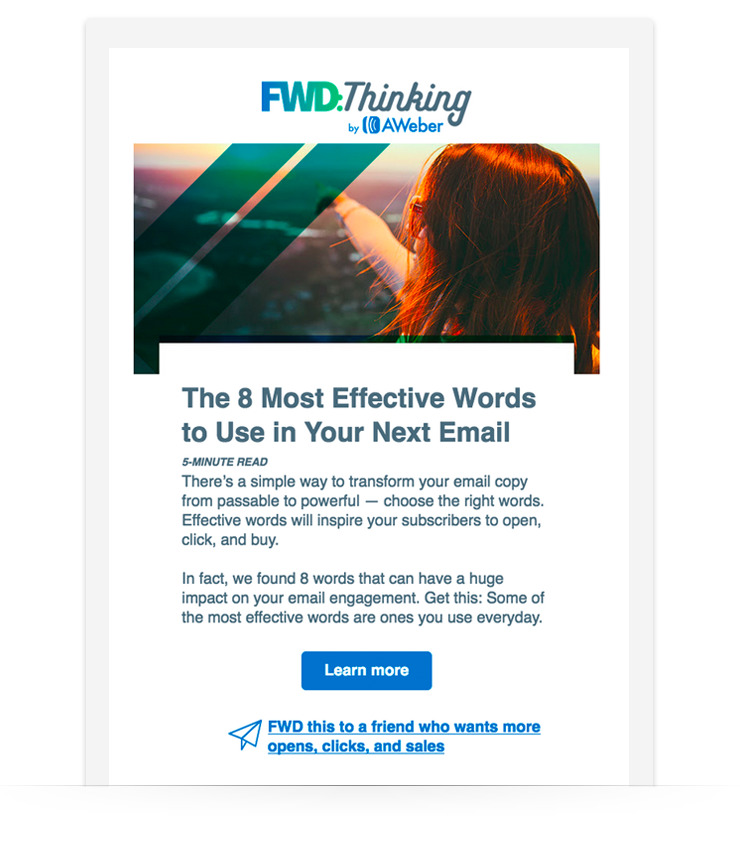
AWeber’s weekly newsletter FWD: Thinking is an HTML email.
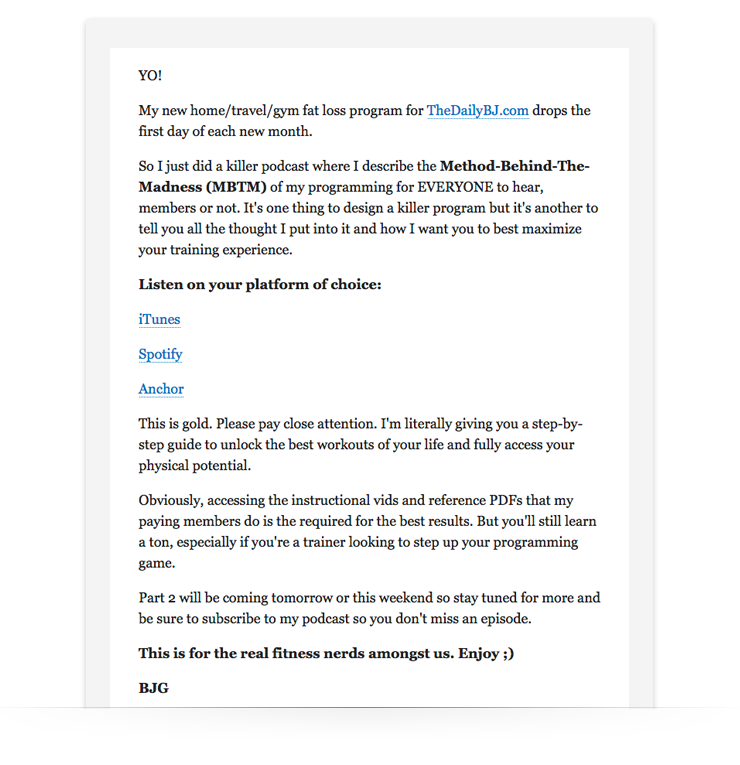
But this message from fitness expert BJ Gaddour is also an HTML email.
It doesn’t have images. It doesn’t use a fancy template. But it is an HTML email, because it contains bolded text and hyperlinked sentences — both HTML elements.
Most people think this email is a plain-text email, because it looks simple. But it’s not.
What does a plain-text email look like then?
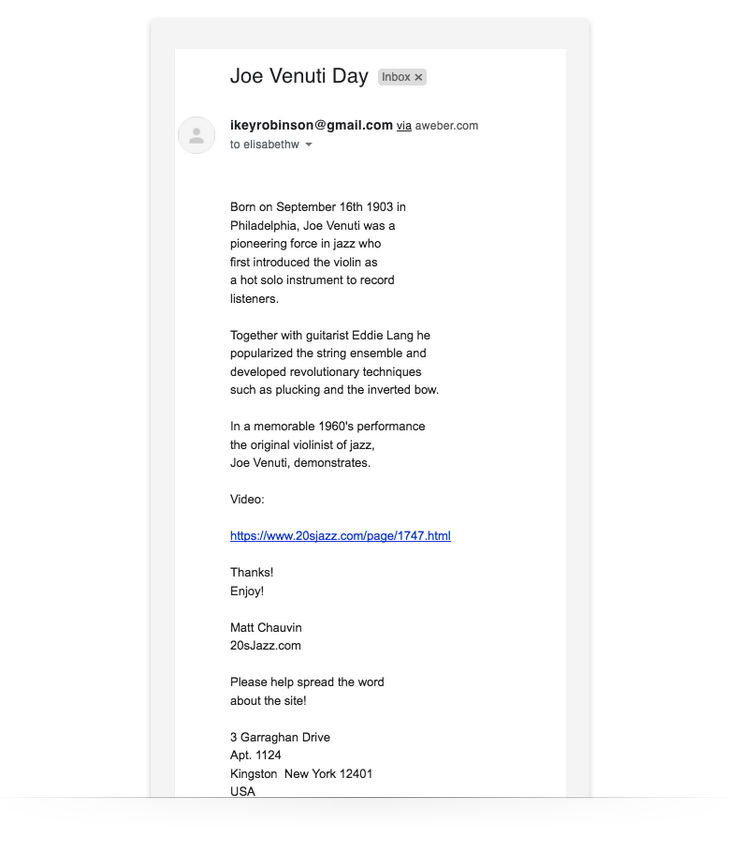
It looks like this.
This email from Matt Chauvin of 20sJazz.com contains no images and no formatting. And notice that a full link is displayed in the email. With plain-text emails, you can’t hyperlink text. (For instance, Matt couldn’t hyperlink the word “Video” in the above email.)
In fact, a plain-text email contains only text, no formatting. But many people incorrectly label HTML emails with limited formatting as “plain-text emails.”
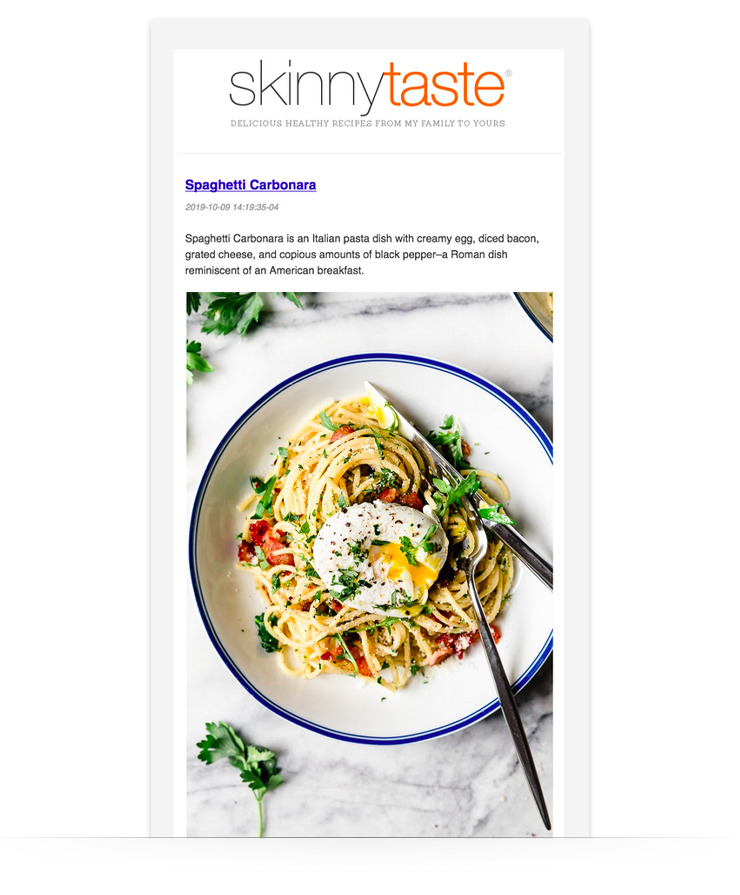
To illustrate the difference between a plain-text and HTML email, here is an HTML email from health food blogger Gina Homolka of Skinnytaste.
You can see there is a logo, italicized font, hyperlinked text (Spaghetti Carbonara), and an image.
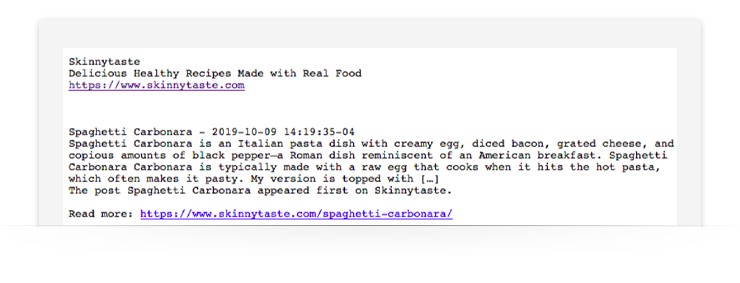
Here is the plain-text version of the exact same email:
Big difference, right? The HTML version is much more visually appealing than the plain-text email. It’s also much more likely that subscribers will want to engage with the HTML version, because they can visualize the food from the recipe.
Spread the word.
Know a marketer or business owner who only sends plain-text or simple emails because they believe it will get them into the inbox? Send them this article.